This review was written by contributing writer Thuy Dinh, an editor of the webzine Da Mau and my resident expert on graphic novels. —PCN
**************************************************************
 As children, my cousin Allan and I would spy on Mrs. Seven, the mean lady who lived next door to our grandparents. She would pray to God then curse at children and beggars. We drew comic strips about Mrs. Seven, putting her in situations that literally exposed her hypocrisy, like having the wind blow away all her clothes on her way to church, leaving her naked, or her long wig snatched and eaten whole by another neighbor’s giant German shepherd.
Because I had so much fun drawing these strips with my cousin, I never thought they touched on anything serious. Later, when I grew older, I felt traditional comics—with their static panels of images and silent dialogue encapsulated in bubbles—were poor relatives of multi-sensory moving images in films.
And yet, I was completely blown away by Asterios Polyp, David Mazzucchelli’s latest “comic book,” a pull-out-all-the-stops package that’s funny, poignant and deep, with panels of thoughtfully shaded images that form a visual novel, a paper movie, and finally, an existential meditation on things that matter to us: religion, art, science, love and memory. In other words, Asterios Polyp manages to embody Up; Synecdoche, New York; and The Curious Case of Benjamin Button without losing its fluid eloquence or sly sense of humor.
At the beginning of the book, Asterios Polyp’s apartment is struck by lightning and, like ancient Troy, goes up in flame. His beloved wife, Hana Sonnenschein (whose Japanese-German name means Flower Sunshine), is nowhere to be found. The book, with flashbacks interspersed with the present, shows Asterios’s progress from hell and back. He is both Ulysses and Orpheus, someone who has to find his way home.
For a work presumably focused on images, Mazzucchelli has a lot of fun with words. Asterios is of Greek descent. His fancy name suggests a polarized nature: star and anal wart (“asterios” means “star, “polyp” can mean a rectal cyst). His dead identical twin, Ignazio, narrates the book and constantly reminds us that our hero is physically and metaphysically divided. Asterios, an arrogant and famous architect, creates buildings that are only models on paper because they have never been built (thus, he’s not unlike a comic book artist, whose world is rendered in two-dimensional images).
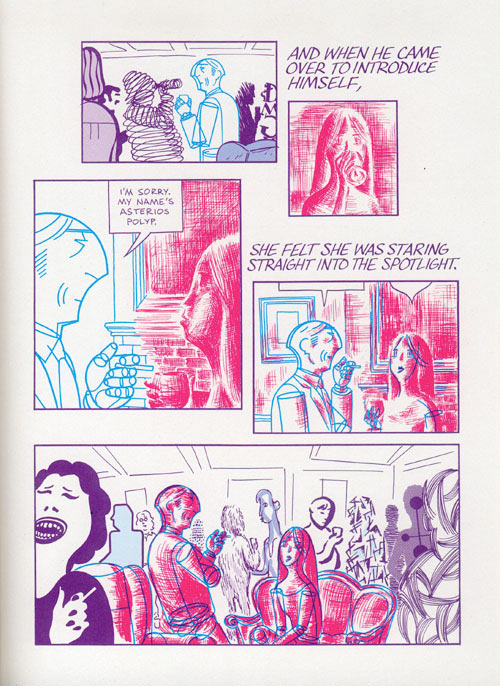
via Comic Book Resources
Mazzucchelli’s graphic novel is also a cosmic quest for beauty. The book is full of contrasting visual shapes, text fonts and color tones, with each form/palette tailored to the personality and philosophical outlook of each character. Asterios is often drawn in linear, geometric form, awash in cool blues. His wife Hana, on the other hand, is often depicted in softer, rounder lines and in warmer coral or pinkish tones.
Another character, Ursula Major (a pun on the constellation Ursa Major), who is like Ceres in Homer’s epic, is often rendered in bright yellow or deep purple squiggles as she represents a mystical earth mother type. This traditional cartoon technique of employing form and color to denote character was most recently seen in the movie Up, where the rounder, more exuberant form of the boy Russell is contrasted with the blocky, rigid lines that make up the old man Carl.
In essence, a story told by Asterios to Ursula Major serves as the main theme of the book: A wooden Shinto temple in Ise, Japan, originally erected in the 7th century, has since been ritually torn down every twenty years and rebuilt, and yet the Japanese would tell tourists the temple is 2000 years old. The riddle suggests that human existence, like a building that’s constantly being destroyed and recreated, must yield to larger forces in the universe.
Asterios, in his lofty reach toward the stars (toward perfection and permanence), doesn’t realize that stars, though lasting thousands of years, can also self-destruct. His search for the meaning of life, like his search for Hana, resonates via the myth of Orpheus—presumably, Asterios must go forward and never look back. The controversial ending of the book makes one wonder if Asterios has indeed gone forward.
Similarly, David Mazzucchelli’s ambitious effort, while shredding the comics/cosmic barriers, is a look back toward the traditional purpose of comics, the ability to wield simple lines and forms to capture—or destroy—everyday reality.







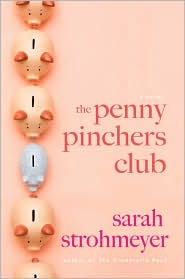 In the midst of all the coupon clipping and Dumpster diving, Kat’s old boyfriend resurfaces, someone who conveniently has loads of cash. Many years ago, he had proposed to her but she turned him down for Griff, choosing the hot, romantic guy over the nice, stable one. A couple of decades later with her marriage on the brink of collapse, Kat wonders if she made the right choice.


 Sacha Baron Cohen plays a flamboyant fashionista from Austria who’s obsessed with fame. After becoming persona none-gayer for literally crashing a fashion show, Brüno goes to Los Angeles seeking stardom despite having no marketable skills. He looks for an agent by (atrociously) reading scenes from Jerry Maguire, tries adopting an African baby to use as accessory, attempts to trap Ron Paul (the 2008 presidential candidate) into making a sex tape with him, and even travels to the Middle East, begging terrorists to kidnap him so he’d receive worldwide attention.
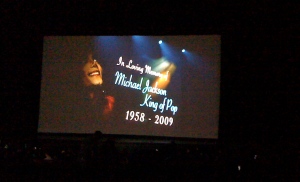
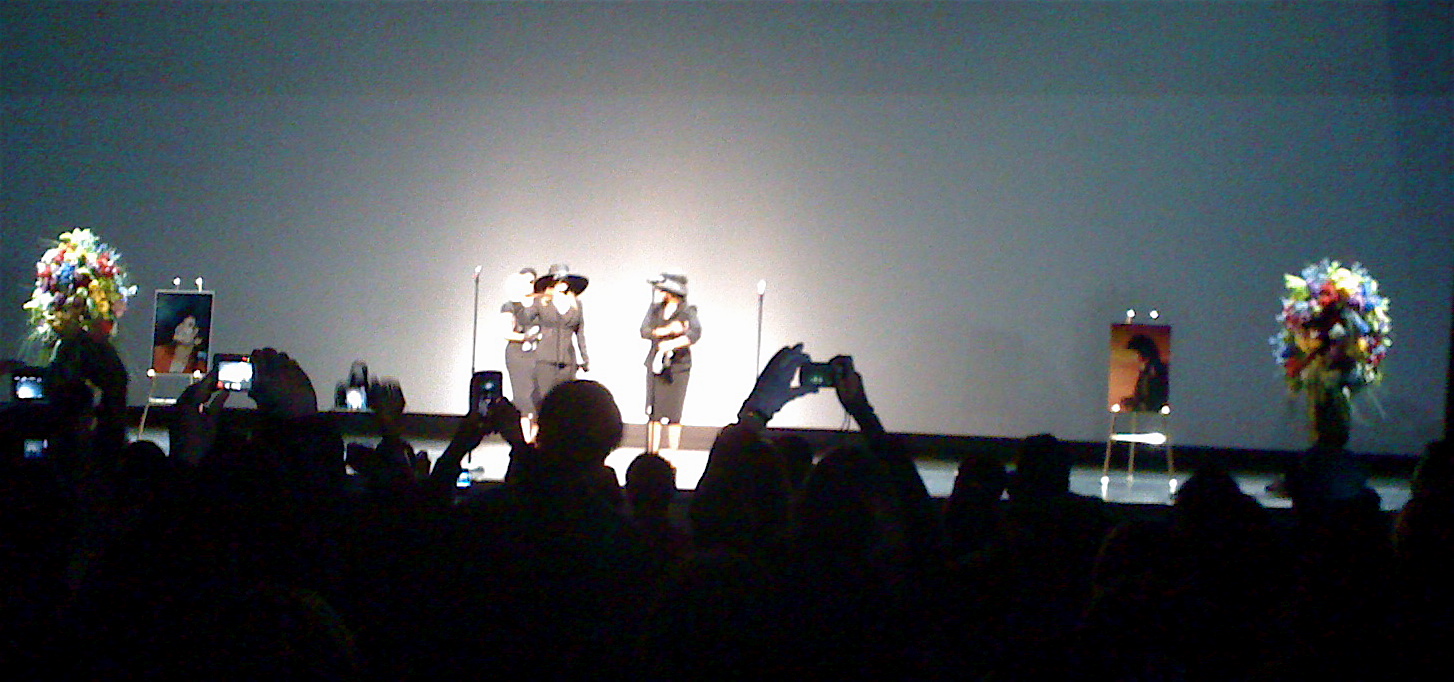
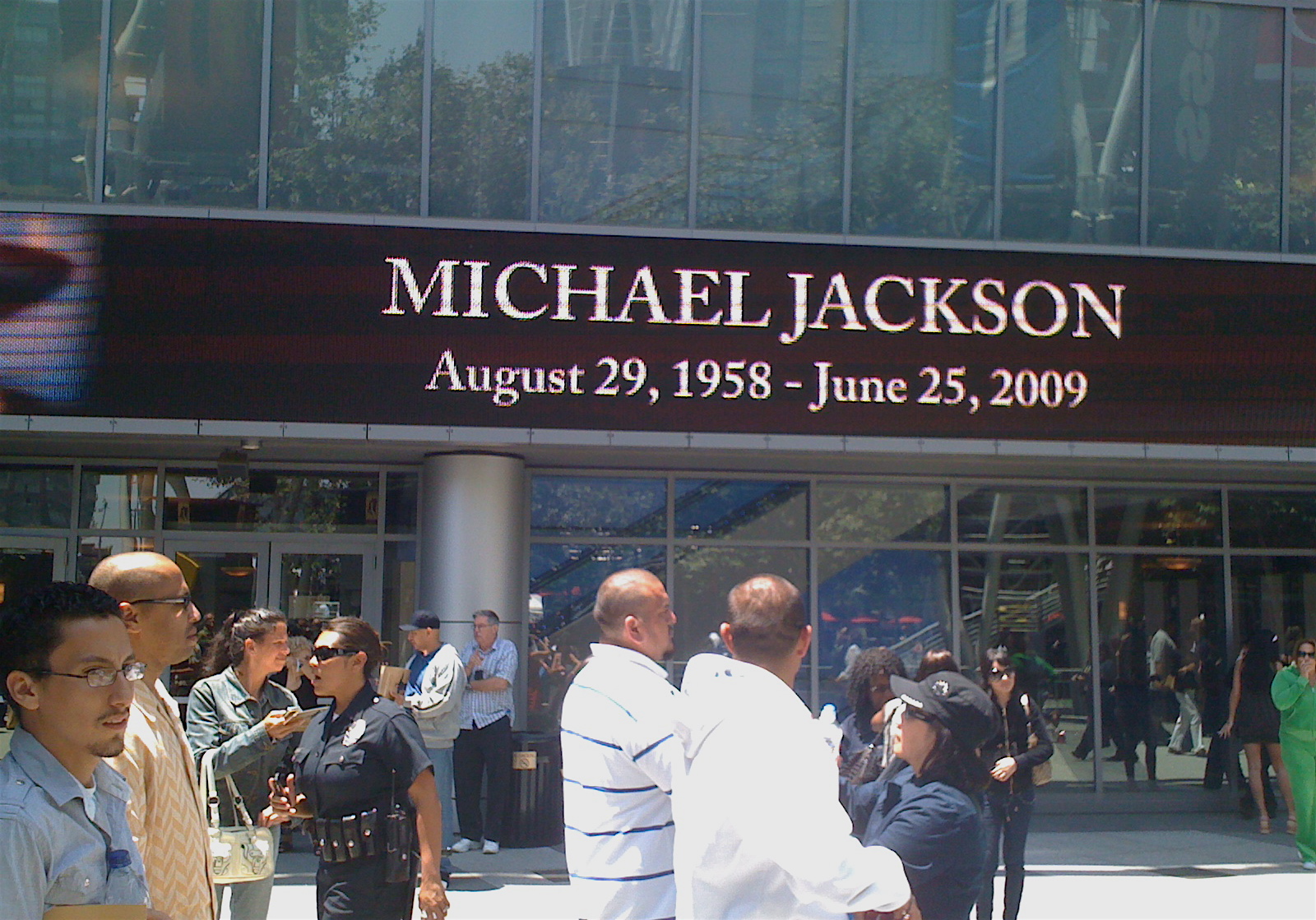
 But a friend of mine, actress-singer Charlene Modeste, won tickets in a lottery to attend the service. I spoke to her afterwards about her emotional experience and she shared some details we didn’t get to see on TV, along with these photos she took.
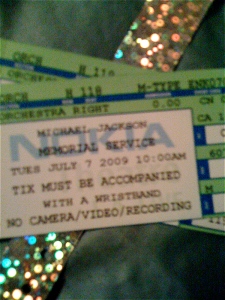 My friend lives downtown so I parked at my friend’s lot and we walked over…There were all these people selling Michael Jackson T-shirts, buttons, posters. Parking lots were $40. Everyone was really calm and respectful, there were cameras pretty much all over the place. Police were checking for wristbands and tickets. There were a lot of people but everyone was really subdued.