Since I have not read Kathryn Stockett’s The Help (don’t hate; it’s in the pile), I went into the screening of the movie (opening August 10) with no expectations or prejudices. I came out with my cheeks all wet.
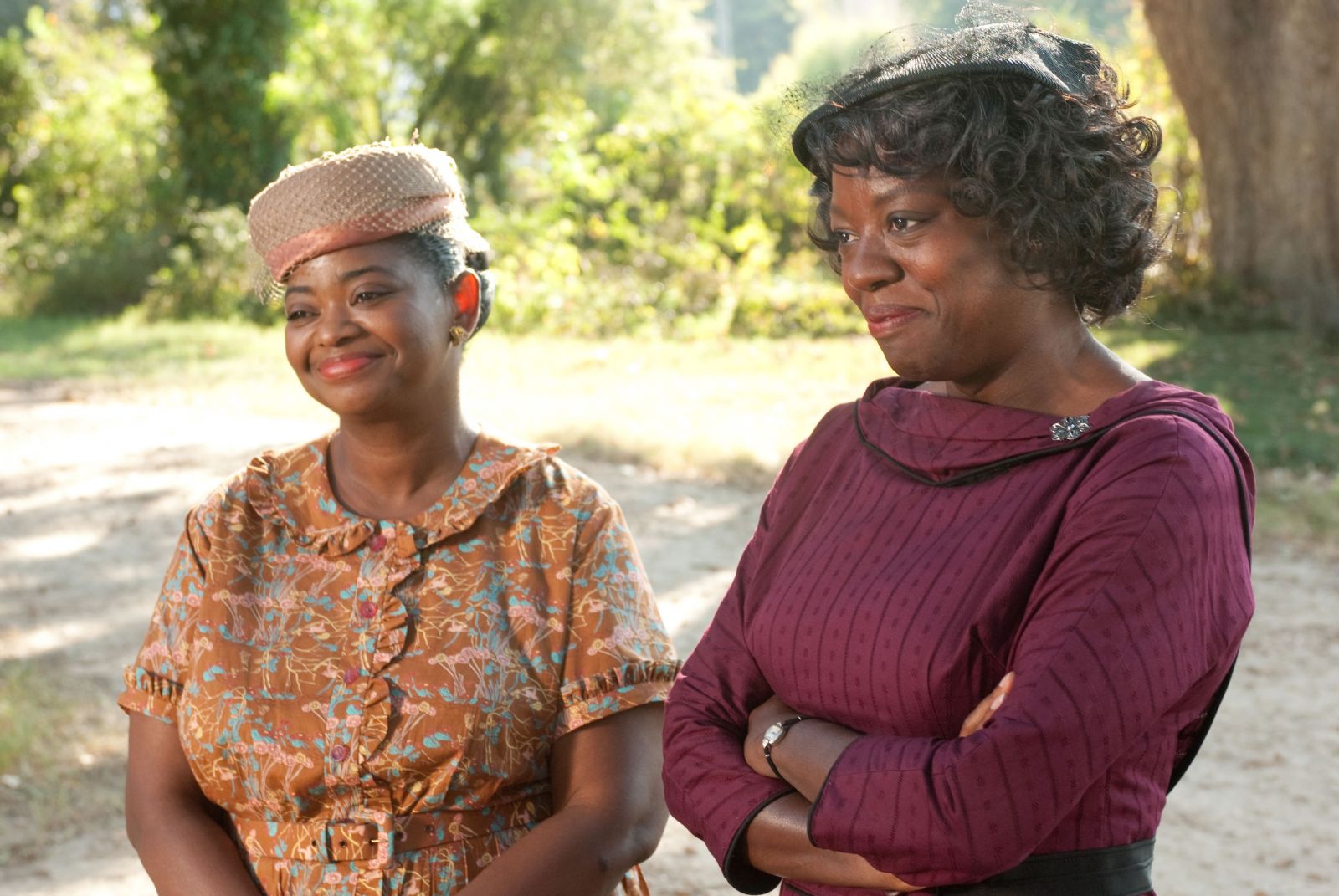
Spencer as Minny (L.) and Davis as Aibileen
In case you’re a Help neophyte like me, the story takes place in 1960s Jackson, Mississippi, and follows the travails of black women working as maids for rich white families. The central figures are stalwart Aibileen (Viola Davis) and sassy Minny (Octavia Spencer). Their lives change when Skeeter (Emma Stone), raised by a maid and newly graduated from college with dreams of being a writer, asks to interview them and tell their stories in a book. Since it was illegal at the time to read or write anything that supported racial equality, the maids resist the idea. That is, until events push them into a corner and they can hold their tongue no more.
While the whole cast is superb, there are a few standouts. Davis anchors the movie with her portrayal of a woman much more dignified than her position in life, carrying a world of wisdom and pain in her eyes. Aibileen’s body may be tired but Davis makes it clear her spirit is still strong. Spencer has a breakout role in Minny, almost stealing every scene she’s in with her spunk and comic timing. Perhaps this isn’t surprising since she says the character is “very, very, very loosely based” on her. (See notes from the Q & A below.)

Chastain as Celia
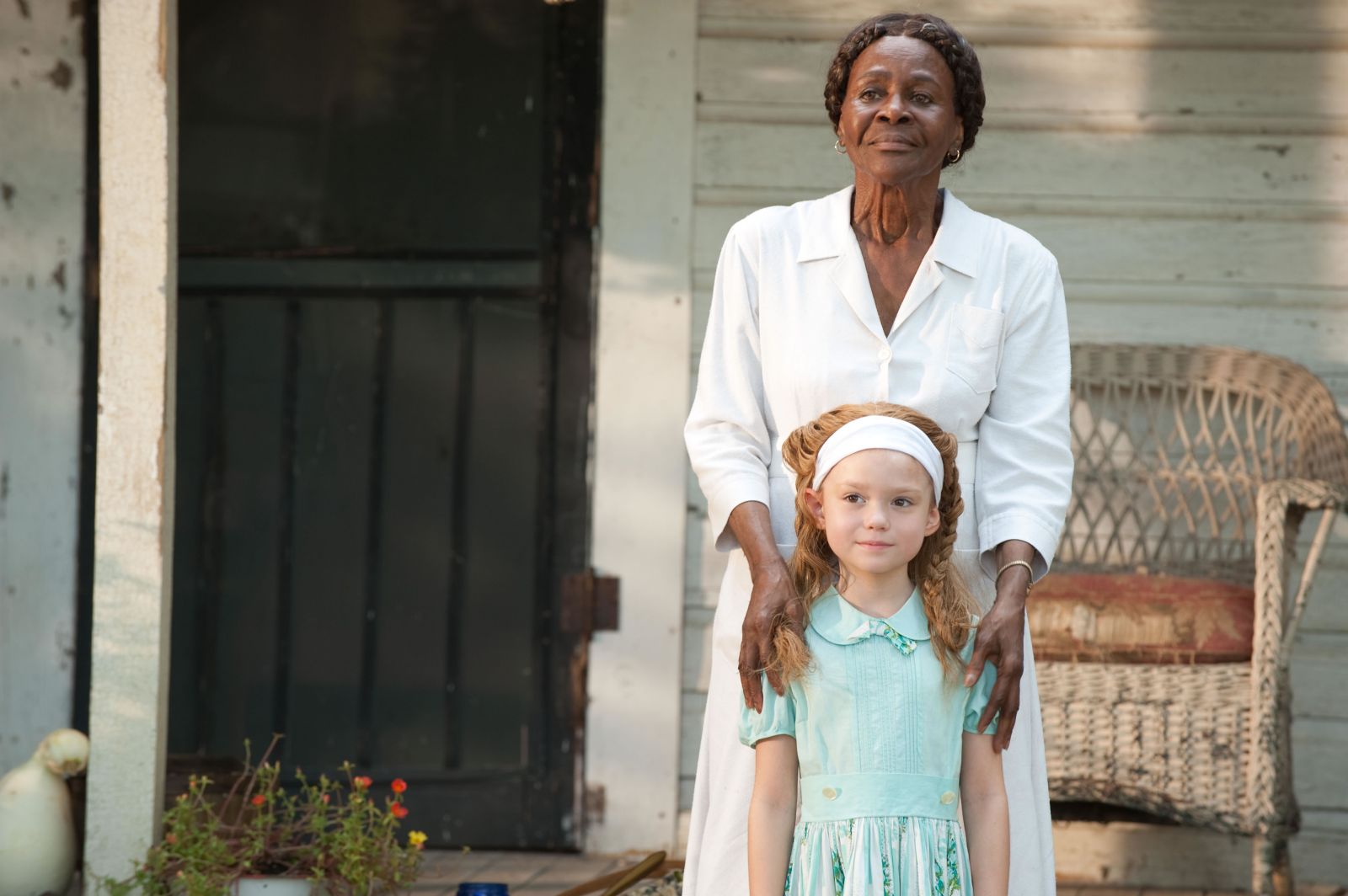
Bryce Dallas Howard plays über mean girl Hilly convincingly because she commits to the character’s ignorance and sense of entitlement. It’s a tricky part she pulls off well. Cicely Tyson has only a couple scenes as Constantine, the maid who raised Skeeter, but she has enough time to make your throat clench up. And Jessica Chastain’s performance as Minny’s employer, Celia, is such a mesmerizing combination of vulnerability, compassion and sex appeal, it explains the actress’s hot streak of prestige films this year (she’s already been seen in The Tree of Life and has about five more projects in the can, including the next Terrence Malick.)
Screenwriter/director Tate Taylor, a friend of Stockett’s from before she wrote the novel, guides the movie with a sure hand. He allows the actors to shine and doesn’t exploit the maids’ suffering. We never see Leroy, Minny’s abusive husband, but we briefly hear the sounds of his violence and can fill in the rest. There are a couple scenes, both involving Allison Janney’s Charlotte, that felt a little synthetic emotionally, but overall Taylor has crafted a truly moving film.
Nerd verdict: Get yourself some Help
After the screening, Davis, Stone, Howard, Janney, Spencer and Chastain (plus a surprise guest) participated in a lively and, at times, poignant Q & A moderated by film critic Pete Hammond. Davis and Spencer were introduced to standing ovations from the audience.
Some highlights of the discussion:
- Davis, who’s from South Carolina, said, “I had a lot of trepidation as a black actress playing a maid.” But she wanted to get involved because “you don’t get many good roles as an actress of color” and it was either “go on a journey” with Aibileen or “have four scenes as a facilitator” in another project. She also didn’t want to be in the audience watching The Help and thinking, “Damn, I want to be in that!”
- About Aibileen, Davis said, “She had no choice. I don’t think she wanted to change the world…she’s not that brave. But she found a purpose as they went along.” When Hammond asked the actress where she thought her character went beyond the story in the novel, Davis said she imagined that Aibileen became a freedom fighter like Fannie Lou Hamer. Spencer interjected, “She opened a restaurant with Minny.”
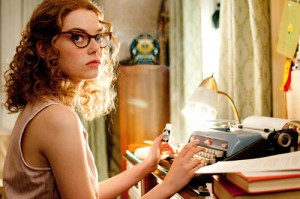 In talking about her experience on this movie, Stone said, “It’s incomparable to anything I’d ever been part of before…My mom was a huge fan of the book. Oh boy, she loved the book.” Hammond asked, “So you had no choice—you had to do it?” “I had no choice at all,” Stone replied. “I don’t know if it was the public school [system] in Arizona but my knowledge of the civil rights era was Rosa Parks and Martin Luther King, Jr. That’s it. The greatest gift was learning about everything and the bonding and friendships between [us]. Except Bryce. She was alienated,” she joked.
- As Howard started talking about her audition for Taylor, Hammond pointed out that the director was in the audience and had him stand up. Then, startlingly, Hammond said that Myrlie Evers-Williams, the widow of slain civil rights leader Medgar Evers, was also in the theater. She stood and waved to a crowd already on its feet to give her a standing ovation. It was an incredibly powerful moment that gave me goosebumps. Her thought on the movie, which touched upon the assassination of her first husband? “I loved it,” she said.
-

Howard as Hilly
Back to Howard, who said she hadn’t read the book when she tried out for the movie. “I was wildly enthusiastic [after I got the part] but then I had a panic attack. I had a Cruella De Vil version in my head but didn’t understand [Hilly’s] psychology at all. I totally judged her.” Eventually, she built a backstory for Hilly, about how people fed her false information that she believed. “She really thought she was doing the right thing. She was ignorant.”
- Janney said she related to Charlotte “because she was afraid of change and sometimes I’m afraid of change…I loved the journey I got to go on, giving Skeeter back her mother.” She said the production had “the best dialect coach. The people down in Greenwood [Mississippi, where part of the movie was shot,] let us come into their homes and just listen to them.”
- Spencer said that Minny is “very, very, very loosely based on certain aspects of my personality. I met Tate sixteen years ago when we were doing A Time to Kill. I was 100 pounds heavier, we were in New Orleans, and Tate, for whatever reason, wanted to take a walking tour.” It was hot, the two were bickering, and “that is when I met Kathryn. Aibileen was regal so Minny had to be short, fat and on fire.” Hammond asked if she went after the role. “The studio was like, ‘[Should we go with] Jennifer Hudson, or this person you don’t know?'” At this point, Spencer put on a fierce stare, as if she was giving a studio exec the evil eye. “It’s the person you don’t know.”
- Spencer added, “We forgot to say thank you to the Myrlies and Martin Luther Kings. This was a way to say thank you.”
 Chastain said, “I really, really fought for [Celia]. I auditioned and read with Octavia. I knew our combination wouldn’t be the same as any other combination…I became obsessed. I had to play this role.” She went on to praise Taylor’s vision and how he became a cheerleader for her. “Somehow he could see me gaining weight, the boobs, the voice,” said the actress, who, with her petite frame and strawberry blond hair, looked drastically different from the busty platinum bombshell she played.
- Chastain also told a story about meeting a woman at a party shortly before production began, when she hadn’t quite found her character’s voice yet. The woman sat down next to Chastain and “started talking to me in this voice that sounded like Celia. Then she said, ‘I’m Kitty’s [Stockett’s] mom.’ Octavia and I took her to lunch and I recorded her. She was an extra in the movie” and at one point stood next to Chastain and announced, “I inspired this figure.”
- The cast said they had two weeks of rehearsal, more than they’re usually afforded on movie productions. “Tate really fought for it,” Howard said. “We rehearsed in the houses we were shooting in. They became our houses.”
-

Tyson with Lila Rogers as young Skeeter
Davis said Cicely Tyson’s legendary performance in The Autobiography of Miss Jane Pittman was what made her pursue acting. She “grew up in abject poverty” and was incredibly inspired when she saw “an expert craftsman…who looked like me.” In watching The Help, “To look up on the screen…” Her voice broke off, choked with emotion. “It’s like my life had come full circle,” Davis finally said.